

TB-500 is a synthetic peptide derived from Thymosin Beta-4, a naturally occurring protein involved in tissue regeneration and cellular repair. Research suggests TB-500 promotes healing by enhancing cell migration, stimulating new blood vessel formation (angiogenesis), and reducing inflammation at injury sites. These properties have made it of interest for improving recovery of muscles, tendons, ligaments, and other soft tissues. Experimental studies also indicate benefits for cardiovascular and neurological repair.


DOSAGE GUIDANCE
The standard weekly dose of TB-500 is a total of 5.0 mg, often administered as 2 separate 2.5 mg doses within 1 week.
This approach addresses acute injuries or recovery goals over 4–8 weeks, then shifts to monthly maintenance.
An alternate dose of 0.5-0.7 mg per day is recommended for those with ongoing or chronic conditions looking for more consistent tissue support.
(The total weekly dose remains 3.0–5.0 mg, but is administered in smaller daily injections.)
Standard Dosage Protocol:
2.5 mg, 2x Weekly = 5.0 mg Weekly
Over a period of 4-6 Weeks
For a standard regimen, reconstitute 10.0 mg with 2 mL.
This yields 5.0 mg/mL.
1. Draw 2.0 mL of bacteriostatic water into a sterile syringe.
2. Inject the water slowly along the vial wall to reduce foam.
3. Gently swirl/roll the vial, avoid vigorous shaking.
4. To store, refrigerate the reconstituted solution at 2–8 °C, protected from light.
Alternate Dosage Protocol:
0.5-0.7 mg, 1x Daily = 3.0-5.0 mg Weekly
Over a period of 4-8 Weeks
For an alternate regimen, reconstitute 10.0 mg with 2 mL.
This yields 5.0 mg/mL.
1. Draw 2.0 mL of bacteriostatic water into a sterile syringe.
2. Inject the water slowly along the vial wall to reduce foam.
3. Gently swirl/roll the vial, avoid vigorous shaking.
4. To store, refrigerate the reconstituted solution at 2–8 °C, protected from light.
Note: If injection volume ever dips below 10 units, consider smaller insulin syringes for precision.
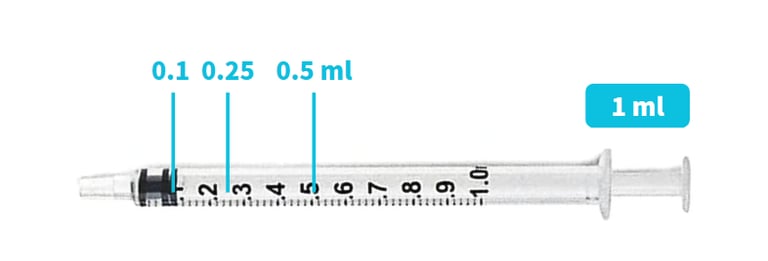
10 units = 0.1 mL
100 units = 1.0 mL
A standard insulin syringe contains 1.0 mL, which is 100 units.